


How Can I Incorporate Desiccant Packs to Control Humidity Inside Crates?
Protecting artwork during transit and storage is a multi-layered challenge that requires attention to detail, especially when it comes to humidity control. High humidity can cause irreversible damage to artworks, including warping canvases, promoting mold growth, and degrading sensitive media such as paper, textiles, and mixed materials. That’s why incorporating desiccant packs into your crating and packaging strategy is essential. In this guide, we will dive deep into how to properly integrate desiccant packs within crates, the science behind humidity control, and how Union Fine Art Services can support you with industry-best solutions for all your art packaging needs.
Why Humidity Control Matters in Art Crating
Artwork is highly sensitive to fluctuations in temperature and relative humidity (RH). Ideal conditions generally lie between 45% and 55% RH, and anything beyond that range can start degrading materials over time. Problems caused by improper humidity include:
- Mold and mildew on canvas and organic materials
- Warpage of wooden panels or frames
- Buckling of works on paper or photographic prints
- Corrosion in metal-based artworks
These risks make it imperative to create a microclimate within each crate that preserves stable RH levels.
What Are Desiccant Packs and How Do They Work?
Desiccant packs are moisture-absorbing agents that remove excess water vapor from the air inside enclosed environments. The most common types include:
- Silica gel: A porous, granular form of silicon dioxide that adsorbs moisture
- Clay desiccants: Natural, low-cost options for general use
- Molecular sieves: Synthetic materials designed to absorb specific molecules, including water vapor
Desiccants work through physical adsorption: moisture clings to the surface of the granules. Once the desiccant reaches saturation, it must be replaced or reconditioned.
Choosing the Right Desiccant Type for Your Crates
Choosing the correct desiccant depends on the type of artwork, the crate’s size, and the expected transit or storage conditions.
| Desiccant Type | Best For | Humidity Range | Pros | Cons |
| Silica Gel | Paintings, prints, and mixed media | 40-60% | Stable, non-corrosive | Must be replaced often |
| Clay Desiccants | General art and object storage | 50-70% | Cost-effective | Less efficient in RH >60% |
| Molecular Sieves | Archival materials, photography, metals | <40% | Highly efficient | More expensive |
At Union Fine Art Services, we tailor our desiccant selections based on your medium, location, and duration of transit or storage. Our experts conduct environmental risk assessments before crating to determine the most suitable humidity control method.
How to Calculate the Right Amount of Desiccant
To effectively control humidity, you need to calculate the amount of desiccant required based on:
- Volume of the crate (length x width x height)
- Material permeability (wooden crates vs. vapor-barrier lined crates)
- Duration of storage or shipment
- Climate of origin and destination
Rule of Thumb: Use approximately 1 unit of desiccant per cubic foot of crate volume for moderate humidity conditions. One unit of desiccant typically absorbs about 6 grams of water vapor.
Union Fine Art Services uses advanced modeling tools and climate data to make precise desiccant calculations, ensuring cost-effectiveness without compromising protection.
Placement Strategies for Desiccant Packs in Crates
Proper placement ensures even moisture absorption and reduces the risk of damage. Here are the key best practices:
- Distribute evenly: Place packs in all four corners of the crate
- Avoid direct contact with artwork: Use foam buffers or fabric liners
- Combine with barrier layers: Use polyethylene vapor barriers or Tyvek wraps
- Secure packs firmly: Prevent movement during transit
For delicate works like pastels or antique manuscripts, Union Fine Art Services installs internal microclimate chambers with integrated desiccant compartments.
Combining Desiccant Packs with Other Climate Control Methods
Desiccant packs should be part of a comprehensive strategy that includes:
- Climate-Controlled Transport: Union FAS offers temperature- and humidity-regulated vehicles.
- Double-Walled Crates: Insulating materials can buffer against external temperature and RH shifts.
- Internal Sensors: Data loggers to monitor RH and temperature in real-time
- Vapor Barriers: Aluminum or polyethylene sheeting that restricts moisture entry
Crate Design Considerations for Optimal Humidity Control
The crate structure directly influences humidity control effectiveness. Key design components include:
- Seal-tight construction: Tongue-and-groove joints, rubber gaskets
- Foam insulation: Closed-cell polyethylene or Ethafoam®
- Built-in compartments: For secure desiccant placement
- Reusable access ports: For inserting data loggers or refreshing desiccants without opening the crate
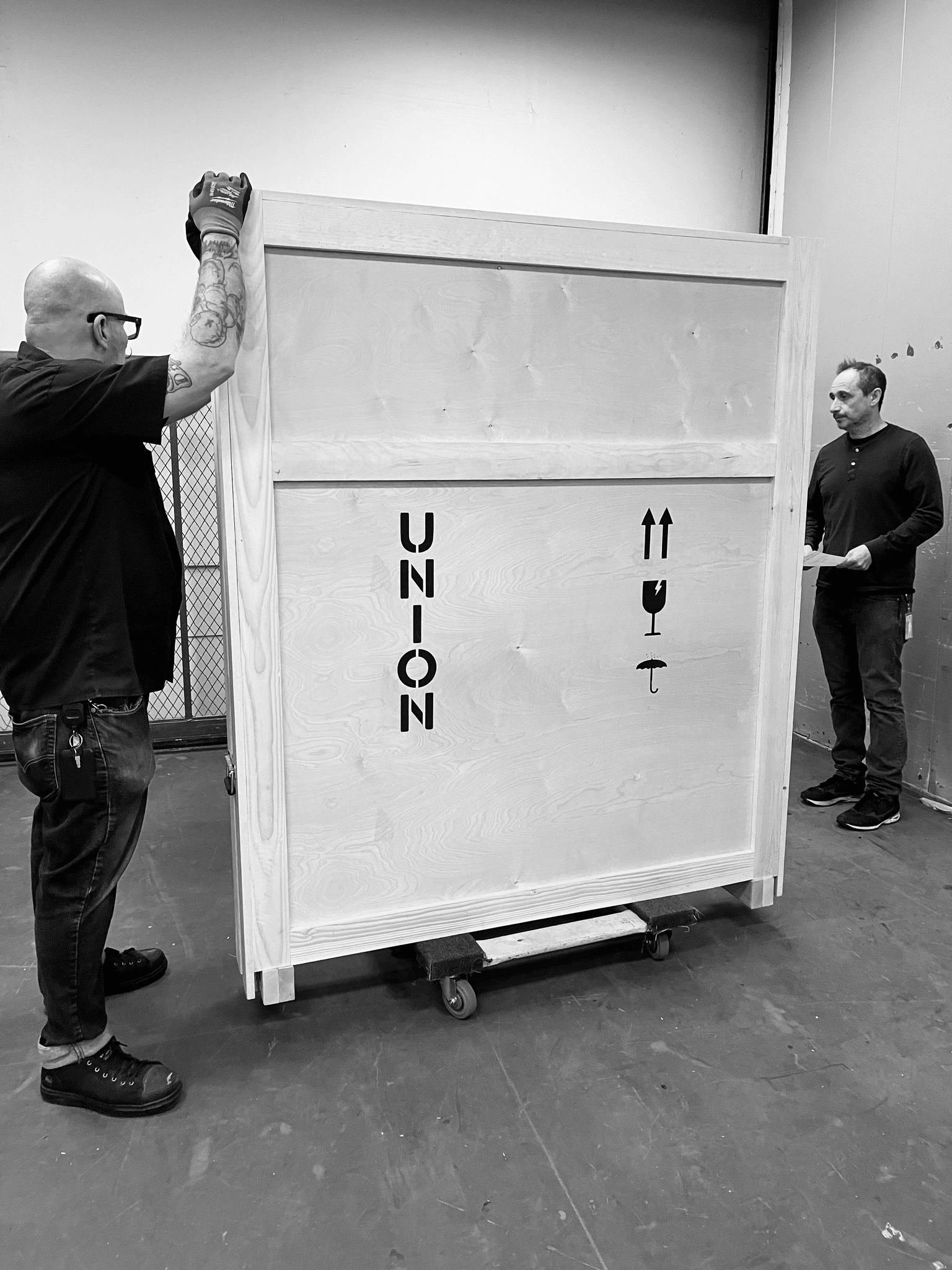
At Union Fine Art Services, we engineer custom crates for every project. Our fabricators can include desiccant compartments, sensor access ports, and insulation layers as part of the crate build.
Monitoring and Replacing Desiccants
Even the best-packed crates need ongoing monitoring, especially for long-term storage.
- Use humidity indicator cards: These show RH levels visually
- Install wireless data loggers: Track environmental conditions without opening the crate
- Set replacement schedules: Depending on climate and duration, desiccants should be replaced every 3-6 months
Union FAS offers ongoing condition checks and re-packing services for clients storing collections over time.
Why Partner with Union Fine Art Services?
When it comes to humidity control and packaging expertise, Union Fine Art Services offers unparalleled experience:
- Custom crate design tailored to artwork sensitivity and destination
- Climate modeling to determine optimal desiccant configurations
- In-house fabrication for full control over materials and specifications
- Logistical coordination, including climate-controlled transport and bonded storage
Whether you’re shipping to a local gallery or preparing for an international museum loan, we provide white-glove handling, robust documentation, and complete environmental protection.
Final Thoughts
Incorporating desiccant packs to control humidity inside crates isn’t just a precaution—it’s a necessity for safeguarding valuable artwork. When paired with expert crate design and professional handling, desiccants provide a cost-effective and highly reliable method for maintaining ideal microclimates. Union Fine Art Services brings decades of experience in art logistics, packaging, and climate control to ensure your artwork arrives and remains in pristine condition.
Visit Union Fine Art Services today to consult with our experts and explore our complete range of art packaging and transportation solutions.